Overall Score: 9/10
DeepSeek V4 Flash 0731 is an incredibly small, cheap, and intelligent AI model that manages to punch far above its weight class in almost every practical scenario you throw at it. It does not top the absolute frontier benchmarks, and it was never really designed to, but it stands out as one of the most usable and cost-effective models available in 2026, functioning as a genuine workhorse that consistently delivers solid results without any of the drama or unpredictability you sometimes get from larger and more expensive systems.
The only real reason it loses a single point comes down to its verbosity, which is the one persistent characteristic that keeps it from achieving a perfect score. According to extensive testing across a wide range of tasks, it produces the second-highest number of output tokens per task of any major model currently on the market, and this means that it tends to feel noticeably slower during interactive use while generating a great deal more text than most situations actually require. That said, its extremely low pricing more than offsets any cost concerns you might have, keeping the effective price per task remarkably competitive even when the model decides to write far more than it needs to.
DeepSeek's highly anticipated next-generation model, V4 Flash 0731, officially released on July 31, 2026, and it turns out to be a genuinely strong release that builds naturally on the company's growing reputation for delivering outsized performance at rock-bottom prices that repeatedly undercut the competition.
Technical Overview and Specifications
Under the hood this is a sparse Mixture-of-Experts architecture with roughly 284 billion total parameters, of which only about 13 billion are active during any given inference pass, which is a large part of why the model stays so cheap to run despite its capabilities. It retains the same efficient design philosophy as its predecessor while receiving substantial additional post-training that focuses heavily on agentic capabilities, coding, reasoning, and a meaningful reduction in hallucinations across the board.
The key statistics tell a compelling story about where this model fits in the broader landscape.
|
Metric
|
Value
|
Commentary
|
|
Input / Output Price
|
$0.14 / $0.28 per 1M tokens
|
Extremely competitive, especially once you factor in DeepSeek's aggressive cache-hit discounts
|
|
Context Window
|
1M tokens
|
Outstanding for large codebases, long documents, and complex agent workflows
|
|
Intelligence Index
|
50
|
A ten point jump from the previous Flash version, landing it comfortably in the mid tier
|
|
Cost Per Task
|
$0.03
|
Among the best value figures anywhere in its intelligence class
|
|
Output Tokens Per Task
|
46k
|
The second-highest verbosity observed, which drives the model's single downside
|
What these numbers ultimately reveal is that this is not a flagship model built to win every leaderboard, but rather one that lands squarely on the Pareto frontier for intelligence versus cost, which is arguably a far more useful place to be for most real world applications. The difference between an Intelligence Index of 50 and one of 57 or 61 is often much smaller in day to day practice than the enormous gap in price and speed that separates those tiers, and for the overwhelming majority of tasks that gap simply does not matter.
Performance Strengths
The 0731 update brings meaningful and clearly measurable gains in agentic tasks, tool use, terminal operations, and long-context reasoning, all of which are the areas that matter most for people building real applications. Hallucination rates have dropped noticeably compared to earlier versions while accuracy on difficult science, mathematics, and coding benchmarks has improved across nearly every category that was tested.
In everyday use the model feels reliable and surprisingly creative, and it requires considerably less hand-holding than many of the cheaper models it competes against. It tends to produce clean, well-structured code with sensible comments and logical architecture, and its full million token context window makes it particularly strong whenever you are working with entire repositories, lengthy research papers, or multi-step agent scaffolds that need to keep track of a great deal of information at once.
The Verbosity Trade-off
The main criticism becomes obvious the moment you look at the data. At an average of forty six thousand output tokens per task, V4 Flash 0731 genuinely loves to explain itself thoroughly, and sometimes it explains itself well past the point of usefulness. It will frequently offer multiple approaches to a single problem, layer in detailed commentary, add various safety notes, and produce extended explanations even in situations where a short and direct answer would have served the user far better.
This naturally increases latency and can make longer conversations feel less responsive than they should, and in time-sensitive applications or long agent chains those extra tokens accumulate quickly. Even so, at these prices the actual economic impact remains almost negligible, and if DeepSeek finds a way to rein in the verbosity in a future update without sacrificing any of the underlying capability, this model could very easily climb to a perfect score.
Real-World Test: Building a Minecraft Clone
One of the most revealing ways to evaluate a model's practical coding and agentic ability is to hand it an ambitious and deliberately open-ended creative task and see how far it can get on its own, so I gave it the simple instruction to make a clone of Minecraft and then stepped back to watch what it would do.
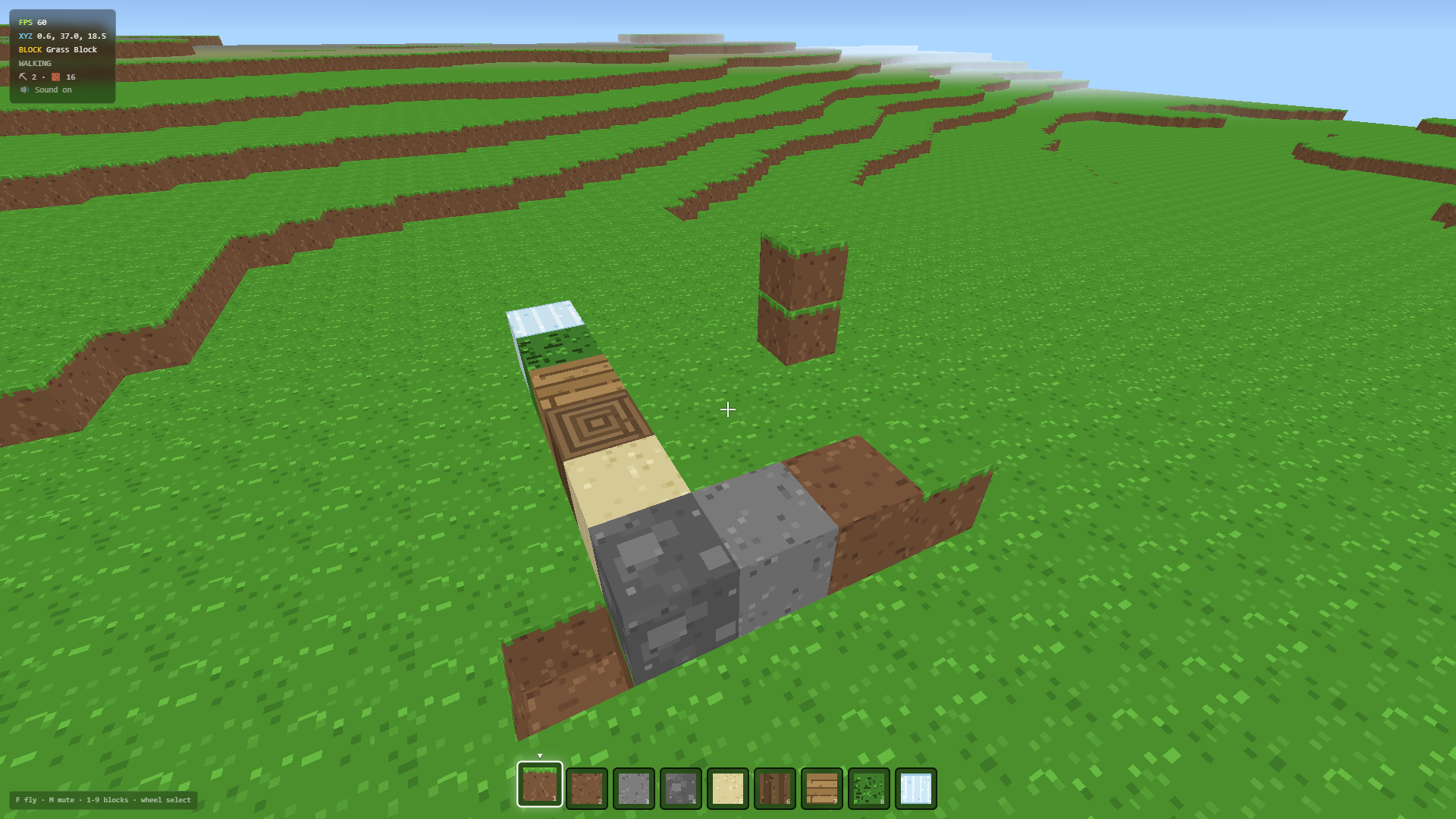
The results were genuinely excellent and exceeded what I expected from a model at this price point. DeepSeek generated a complete 3D voxel engine built in the browser using Three.js and modern JavaScript, and it included a procedural terrain generation system with hills, caves, and distinct biomes, along with block breaking and placement that felt satisfying and physically grounded. On top of that it added a basic inventory and crafting system, a functioning day and night cycle with dynamic lighting, and smooth first-person controls backed by sensible chunk loading optimizations that kept everything running smoothly.
The first output contained a single minor bug, which turned out to be a straightforward import and path issue, and once I fixed that one small problem the game compiled cleanly and ran beautifully on the first proper attempt. The total time from the initial prompt to a fully playable experience came to approximately twelve minutes, which is remarkably fast for something this complete.
Browser-based 3D voxel engine generated by DeepSeek V4 Flash 0731 in 12 minutes
The visual style captures that instantly recognizable blocky Minecraft charm, and most importantly the finished result actually plays well rather than simply looking the part. Movement feels responsive, block interactions are intuitive, and the core gameplay loop is genuinely enjoyable in a way that goes well beyond a throwaway technical demo, which is exactly why the workhorse label fits this model so naturally, because it takes an ambitious idea and turns it into working software quickly and cheaply.
Pros and Cons
On the positive side, the model offers an outstanding price to performance ratio, strong real world coding and agentic capabilities, a full million token context window, and excellent value for anyone doing high volume or production work. It now ships with open weights available for local deployment, and it delivers significant improvements in both agentic performance and hallucination reduction compared to the version that came before it.
On the negative side, its high verbosity remains the defining weakness, it is not the absolute leader on pure intelligence benchmarks, and the sheer volume of tokens it produces can make it feel slower than its raw capability would otherwise suggest.
Who Should Use It
This model is an easy recommendation for independent developers, indie hackers, and startups who need to keep a close eye on costs while still shipping quickly, and it works especially well for anyone building agents, internal tools, automation pipelines, or large scale coding projects. It is also a natural fit for people working with enormous contexts or sprawling codebases, and for anyone who wants to maximize the number of iterations and experiments they can afford to run within a limited budget.
You might want to look elsewhere if you specifically need the highest possible reasoning ceiling for the very hardest problems, if you require ultra concise responses with minimal latency, or if you are chasing premium polish in creative writing and conversational interfaces where every word counts.
Final Verdict
DeepSeek V4 Flash 0731 is exactly the kind of model the industry needs a great deal more of, because it is genuinely intelligent, remarkably affordable, and highly capable in precisely the areas that matter most for getting real work done day after day. It may not wear the crown on every leaderboard, but it has earned a permanent place in my daily toolkit, and when you weigh practicality, value, and raw usefulness together it comfortably ranks as one of the best releases of 2026 so far. The final score of 9 out of 10 reflects an outstanding workhorse that carries only a single flaw, and a very fixable one at that.